SEDA Malaysia Pinpoints Solar, Hydro, and Bioenergy as Critical Growth Pillars for Perak's Energy Transition
Released on: Wednesday, 10 Dec 2025 4:30PM
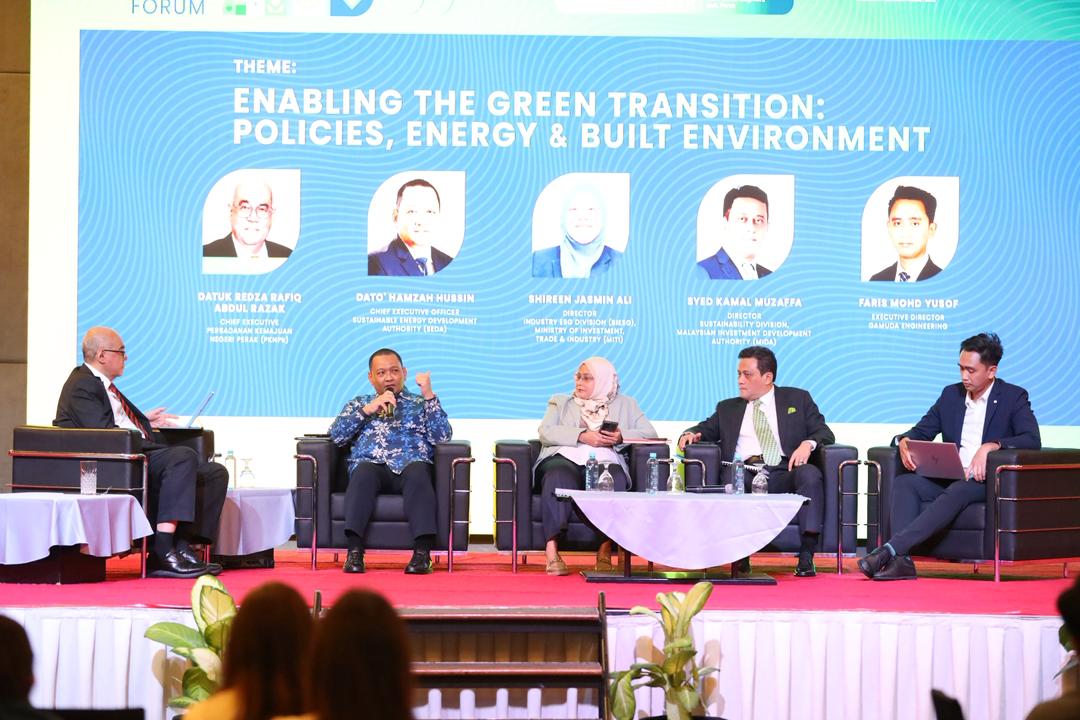
SEDA Malaysia’s Chief Executive Officer, Dato’ Hamzah Hussin, spoke during the session titled “Environmental, Social & Governance (ESG) for Industrial Advantage” in Meru, Ipoh, Perak at the Green Tech Perak 2025 Panel Forum and a booth visit at the event.
MERU, Ipoh, Perak, Dec 10 (Bernama) -- The Sustainable Energy Development Authority (SEDA) Malaysia has highlighted Perak's significant opportunities for accelerating its renewable energy (RE) transition, particularly by focusing on the state's inherent strengths in the solar, hydro, and bioenergy sectors.
At the GREEN TECH PERAK 2025 PANEL FORUM, titled Environmental, Social & Governance (ESG) for Industrial Advantage, SEDA's Chief Executive Officer, YBhg. Dato’ Hamzah bin Hussin, presented a detailed overview of the state’s potential and outlined its key priorities for the next five years.
Perak’s Strong Renewable Energy Foundation and Potential
Perak have already established a substantial RE base and possesses clear potential for expansion. As of October 2025, SEDA has awarded 260.36 MW of projects in Perak under the Feed-in Tariff (FiT) Programme, with the largest capacity coming from small-hydro (161.49 MW), followed by biogas (47.079 MW) and biomass (27.5 MW). A recent SEDA study further identified approximately 78.85 MW of additional viable small hydro potential along suitable rivers in Perak, affirming its status as a hydro-rich state. For the Net Energy Metering (NEM) programme, Perak has been awarded 207.46 MW of quota, with most of the uptake (112.49 MW) being from the NEM3.0 NOVA category, primarily driven by commercial and industrial users.
SEDA recommends that Perak prioritise Hydro and Small Hydro over the next five years, as this aligns directly with the Perak Sejahtera 2030 goal to expand mini hydro projects, especially to supply clean and reliable energy to communities not fully connected to the main grid. Second, the state should continue to support Industrial and Commercial Solar because the demand pattern is already strong under the NOVA programme, even when Accelerated Transition Action Programme (ATAP) replaces NEM, factories and businesses in Perak’s industrial corridors will remain major buyers of rooftop solar and green electricity.
Finally, there is room to grow Bioenergy (Biogas and Biomass), which is supported by Perak’s agriculture and agro-industry profile and can complement the state's energy mix. Furthermore, pre-feasibility findings by the Minerals and Geoscience Department Malaysia (JMG) in 2016 indicated a geothermal potential of approximately 162 MW in Ulu Slim, Perak. The state is also well-positioned to attract green manufacturing in solar components and battery systems.
SEDA’s Key Priorities (2025–2028) for National RE Transition
SEDA’s strategic focus areas for the next three to five years begin with efforts to Scale Up Rooftop Solar Growth by ensuring stable and predictable policy frameworks, supported by more digitalised and user-friendly processes. The Authority will also Expand Community-Energy Programmes to widen public participation through community-based models and shared participation structures. A major focus is to Strengthen Data Governance and Reporting to track RE performance accurately, support evidence-based decision-making, and improve transparency. In parallel, SEDA will Support Emerging Technologies, including battery storage, modern bioenergy systems, and hydrogen pilot projects. Finally, SEDA aims to Build a Competent Green Workforce through structured green-jobs pathways and targeted micro-credential programmes, alongside efforts to Enhance State-Federal Alignment to standardise processes and reduce administrative bottlenecks.
SEDA Strategies for Addressing Industrial Transition Challenges
SEDA is focused on streamlining adoption and providing critical support to address industry challenges. SEDA can streamline rooftop solar approvals by improving coordination between state and federal processes, which shortens approval timelines. SEDA will also continue supporting clean energy adoption through expanded green electricity and corporate procurement mechanisms under CRESS to help companies meet ESG expectations. The common challenge of High Upfront Costs can be reduced through leasing arrangements, third-party financing models, and access to green loan programmes. Issues of Limited Technical Understanding are addressed by strengthening capacity-building programmes, advisory clinics, and clearer technical documentation. For industries facing Grid Constraints, solutions include joint planning between TNB, state authorities, and investors. Reliability Concerns are mitigated by encouraging the adoption of hybrid systems and storage solutions. Furthermore, industries without available on-site resources can participate by purchasing Renewable Energy Certificates (REC) or leveraging Green Electricity Tariff (GET) options. Lastly, Compliance and Reporting Demands can be eased by providing templates, digital tools, and awareness programmes that simplify reporting and certification.
Attracting RE Investors and Preparing Industries
SEDA provides guidance on attracting investors and preparing industries for upcoming requirements. To attract investors, states like Perak can provide clear zoning for solar, hydro, and bioenergy projects. They should also promote “RE-ready” industrial parks pre-assessed for grid access and actively highlight the state’s 78.85 MW of viable small hydro potential as a ready-to-develop pipeline. Regarding industry preparation, companies should be preparing mandatory energy reporting by organizing their energy-use data, appointing or training internal energy managers, and conducting basic energy audits. Key steps also include setting internal consumption targets, upgrading old equipment, and adopting automation and smart metering for real-time tracking.
In his concluding remarks, YBhg. Dato’ Hamzah bin Hussin stated, "Perak has clear strengths it can build on, especially in solar and hydro projects... With coordinated action between the state, federal agencies, investors and industries, Perak can position itself as a leading hub for renewable energy development and help drive Malaysia’s broader transition toward a cleaner, more resilient and more competitive energy future".
ABOUT SEDA MALAYSIA
Sustainable Energy Development Authority (SEDA) Malaysia is a statutory body reporting to The Ministry of Energy Transition and Water Transformation (PETRA). SEDA Malaysia was established in September 2011 under the SEDA Act 2011 [Act 726] with the key purpose of driving the renewable energy and energy efficiency agenda in the country.
SOURCE: Sustainable Energy Development Authority (SEDA) Malaysia
FOR MORE INFORMATION, PLEASE CONTACT:
Name: En. Roslan Ali@Hassan
Senior Director, Strategic Communications Division
Tel: 012-377 6983
Email: sc@seda.gov.my / roslan@seda.gov.my
--BERNAMA